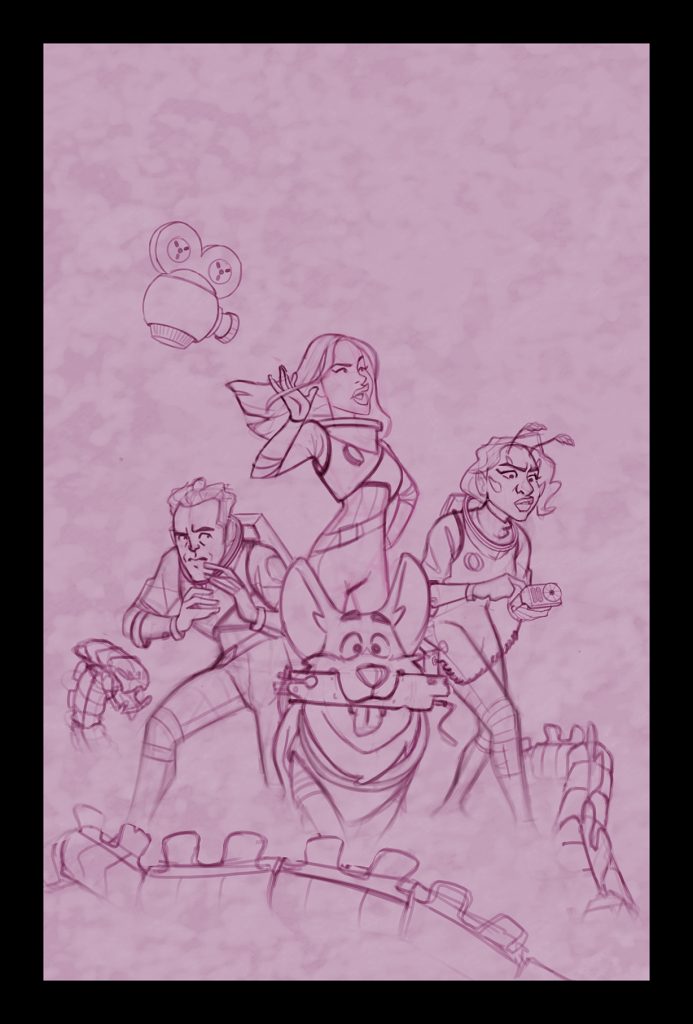
Space Aces: Wreck Runners – Design Retrospective
Tl;Dr: In which I wax on and on and on about designing the various elements of Wreck Runners and share some process pics from the development.
A Fungeon In Spaaaace
Wreck Runners is my love letter to dungeon crawling… filtered through a cracked space helmet and live-streamed to the galaxy.
At its core, it’s my take on a classic dungeon exploration game in the Space Aces universe. The goal was to make building and running a light-hearted sci-fi dungeon as simple, approachable, and enjoyable as possible. Something you can set up and play without needing a three-ring binder, three supplement books, and hours of prep time.
Thankfully space is full of dangerous dungeons in the form of wrecked starships drifting in the vast darkness. Like abandoned industrial buildings of a bygone age, these decaying hulks are home to all sorts of strange sights, crazy dangers, amazing wonders to behold, and maybe even a few treasures to discover among their twisted corridors.
And to be clear, when I say “dungeon” what I really mean is “fungeon”. Wreck Runners lets you create self-contained playgrounds for the brave, bold, and irresponsible.
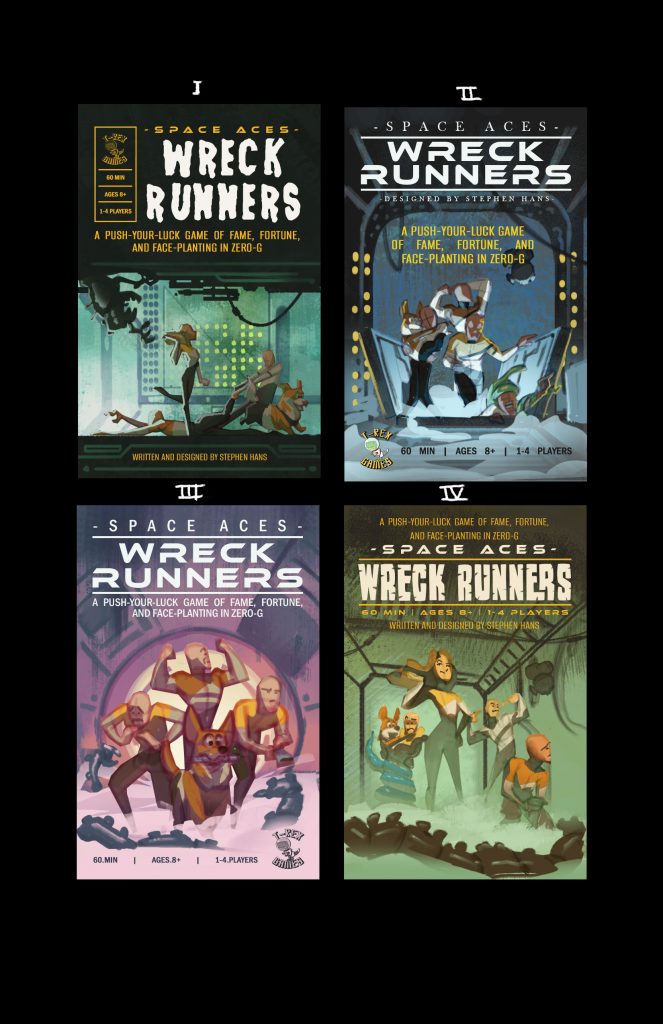
The Themes
I love sci-fi (obviously), and I love the idea of dungeon crawling. Running a crew through tight corridors full of bizarre hazards and quirky denizens is RPG gold.
What i don’t love is horror as a default mode for dungeons. And I really don’t like violence-as-a-solution gameplay. And, I don’t think I’m alone in those preferences.
This left a gap in the market: a dungeon-crawling sci-fi game that’s is more playful fungeon, rather than gruesome horror show.
My goal was a Saturday morning cartoonchaos. Think lighthearted, kinetic, colorful energy, zany, and mischievous. Thrills without trauma. Danger without the despair.
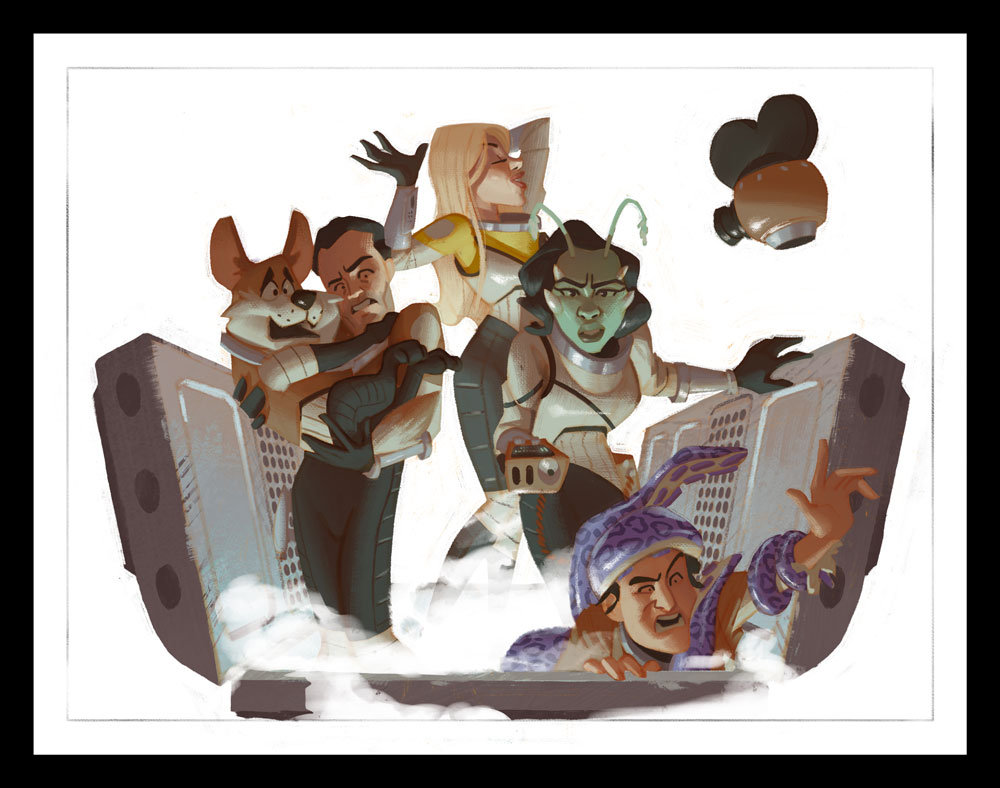
To reinforce that tone, I leaned into live-streamed urban exploration as sport. You’re not profiteers, scavengers, or even heroes. You are attention seeking, fame hungry social media influencers trying to get noticed by doing dumb stunts in dangerous places.
That framing does a lot of heavy lifting. It justifies risky behavior. It encourages spectacle. It turns recklessness into strategy.
And crucially—it shifts the reward structure away from violence.
To avoid “murder-hobo” play, characters wield a versatile multitool slotted with various modules that can be used in creative ways instead of a pile of guns. Creative problem-solving over shooting everything in sight.
Incentivizing Hijinks
If you want players to behave a certain way, reward that behavior. So, I built multiple overlapping systems that encourage spectacle, stunts, shenanigans, and reckless hijinks in space.
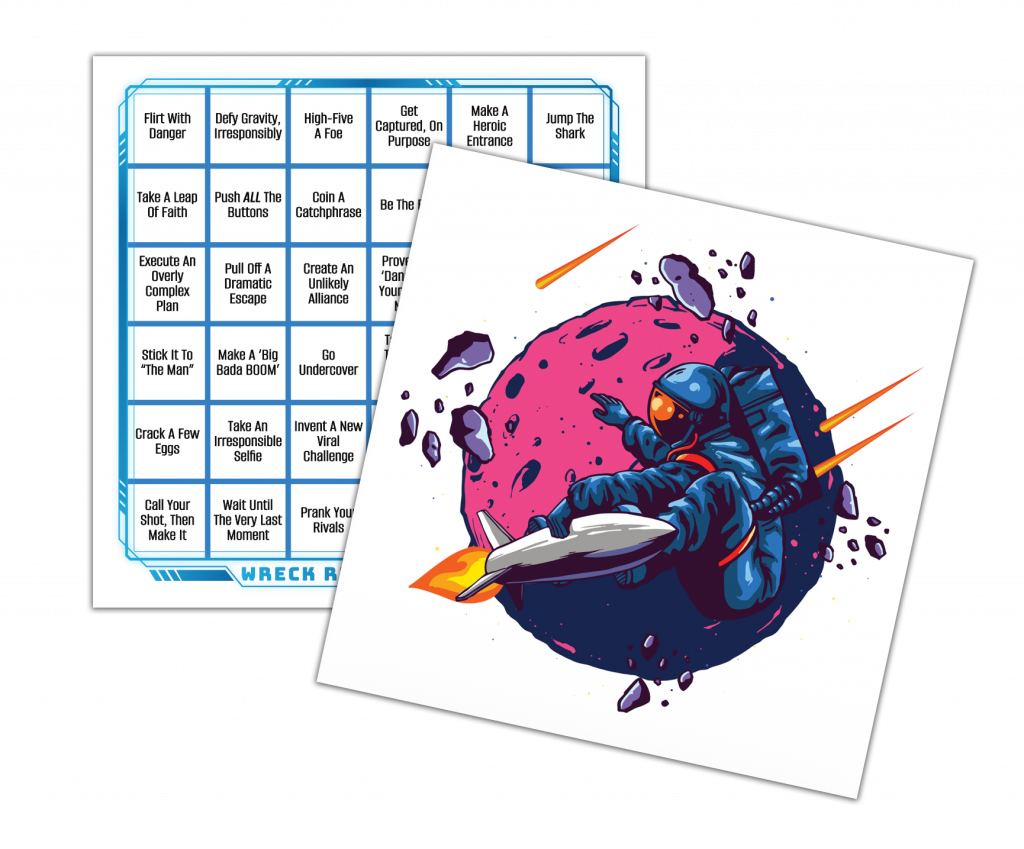
- Five Bingo Cards full of chaotic, stunt-forward prompts.
- The Spacenet Challenges Table for whatever outrageously dangerous trend is currently melting the galactic feed.
- Hype mechanics that reward risk and punish caution.
Score a bingo? Earn bonus Space Cred.
Pull off a trending challenge in a particularly stylish way? More Space Cred.
Play it safe? Your Hype drops faster than a hippo in high gravity.
The goal here was to gently discourage the classic “tap everything with a ten-foot pole” approach. This is not a game about optimal safety. It’s about calculated chaos.
S.C.R.A.M. Beacons
Even in a cartoon, danger needs teeth. But I didn’t want Wreck Runners to become a blood sport.
Enter the S.C.R.A.M. beacon: an emergency teleport system that whisks you away milliseconds before catastrophic demise or after suffering too many consequences. It functions as both a narrative safety net and a mechanical pressure valve.
Sure you won’t die, but your shame will live forever.
This keeps stakes high without derailing campaigns or turning the table somber. Failure is embarrassing, costly, and dramatic but not traumatic.
At first, the S.C.R.A.M. beacon was beautifully simple: on or off.
If something happened that would kill you, it triggered. You vanished in a flash of emergency teleport light, and that was that.
Clean. Elegant. Problem solved.
Except… it wasn’t.
In play, what actually happened was that Runners turned into cartoon pin cushions. They’d stumble from one disaster to the next, accumulating all kinds of “non-lethal” consequences that technically didn’t trigger the beacon. Because death was the only threshold, everything short of it became strangely toothless. Characters just kept dragging themselves forward, battered but functionally fine.
The binary design created a weird loophole: if it doesn’t kill me, I can absorb it forever. So I reworked it.
The updated S.C.R.A.M. beacon now has four levels of alertness. Instead of only triggering at the brink of death, it escalates whenever you suffer significant consequences, even if they aren’t lethal. Do something reckless? Botch a roll? Push too far on a stunt? The beacon ticks up.
Each level represents mounting system concern. You’re not dead, but your beacon’s safety protocols are watching you very closely.
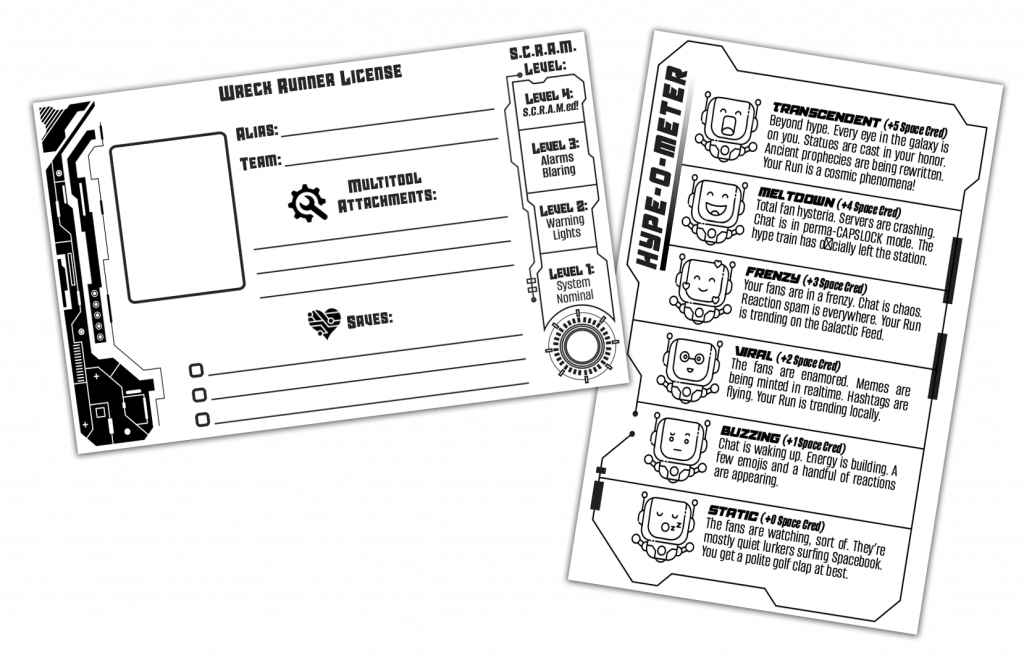
Mechanically, this solves several problems at once:
It creates a clean stand-in for HP without turning the game into a damage ledger. It provides a satisfying “soak” for non-lethal consequences on mixed successes. It builds tension over time instead of only at the point of catastrophe. It makes every reckless decision part of a visible countdown.
Now, when a Runner keeps pushing their luck, you can feel the cost accumulating. You’re one alert level closer to getting yanked out mid-climax. It transforms consequences from cosmetic scuffs into rising pressure.
And most importantly- it keeps the tone intact. You’re not bleeding out in a hallway. You’re one bad stunt away from an embarrassing emergency extraction in front of your entire livestream audience.
Which, in Wreck Runners, might be worse.
The Tiles
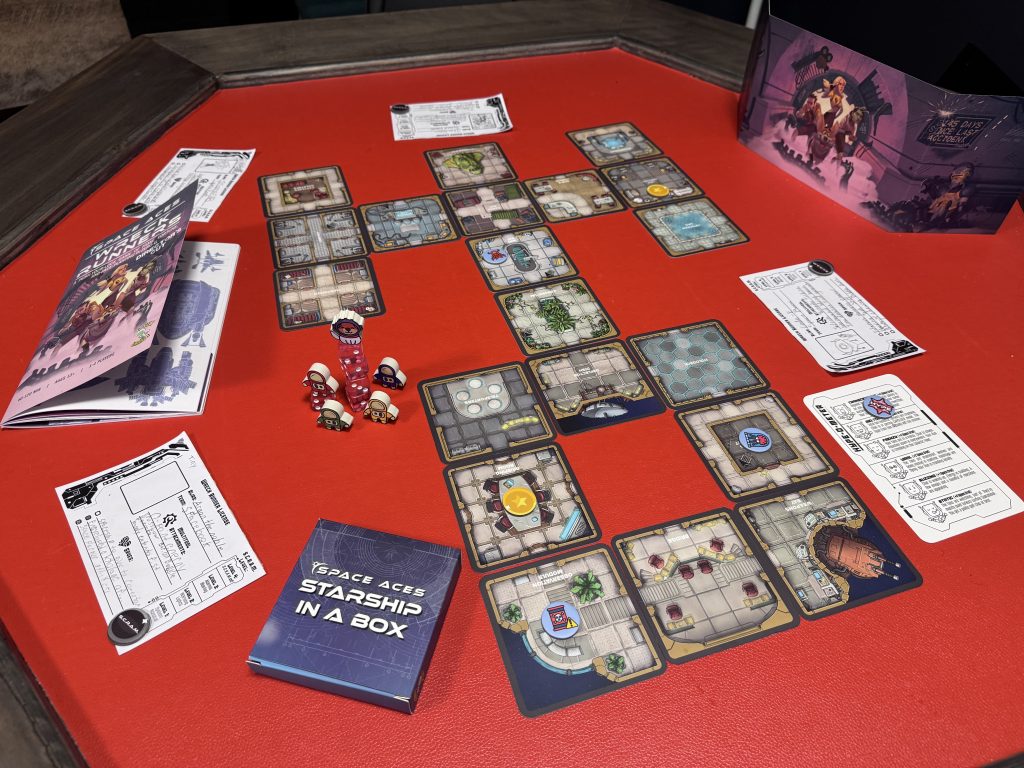
I wanted building a starwreck to feel as easy and inviting as putting together LEGOs. No grid math. No drafting diagrams. Just satisfying, creative assembly with premade blocks.
The 42 double-sided, custom illustrated starship geomorph tiles with unique modules on each of them ensures that there’s plenty choose from to feed your creativity. This was a HUGE up front expense for the game, by far the biggest art expense I’ve taken on to date. But it is one that I hope will be well worth the investment. The tiles make prep tactile. Spark creativity. Provide a visual anchor for players. And guarantee variety.
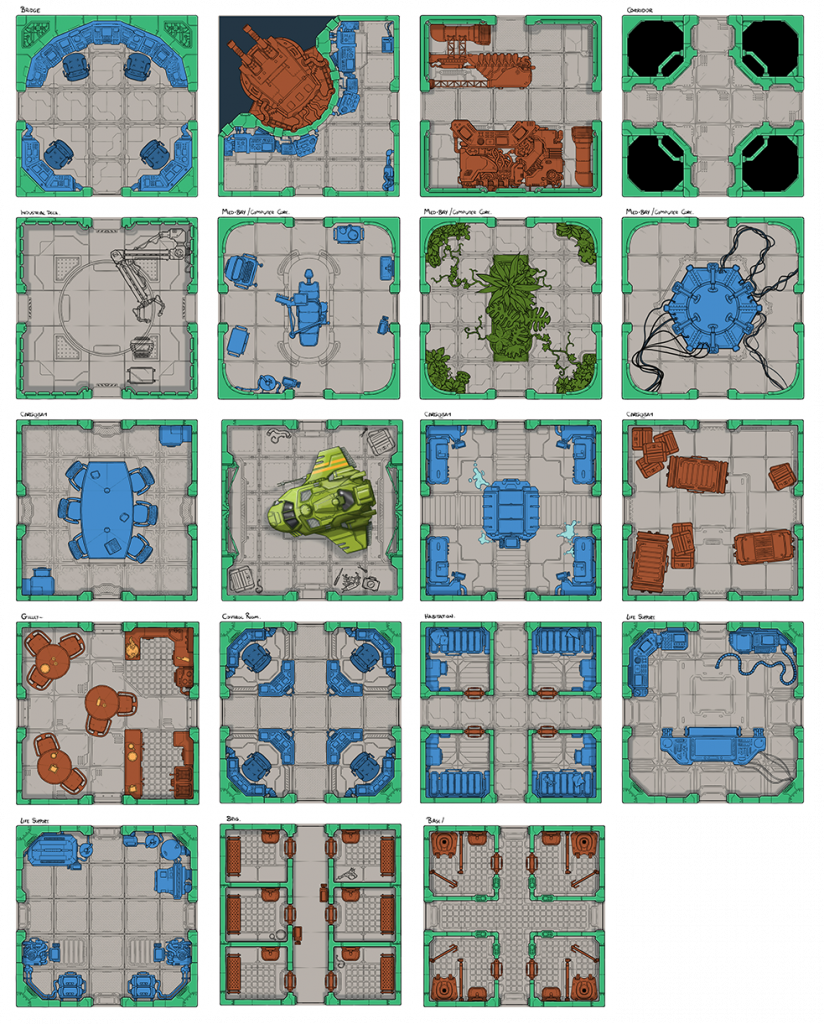
These starship module tiles aren’t just components. They are long-term infrastructure that will be useful in all sorts of other games to build the crew’s ships, outposts, space stations, and whatever else GMs can dream up. I’m already using them to build out the PCs starship for our home game of Space Aces: Voyages.
The Encounters
When delving dangerous locations characters will generally run into either Obstacles (hindering progress), Threats (endangering life and limb), or interesting Denizens (weird inhabitants worth interacting with).
To keep prep light, the GM only needs to create six unique major threats ahead of time. That’s it. The rest of the encounters can be found in the various tables in the book. This preserves variety while protecting the GM from burnout. You get surprise without chaos.
The magic really happens in combination encounters like a denizen tangled up in a threat, or an obstacle that becomes dangerous under pressure. These layered moments create the most memorable scenes because they feel emergent rather than scripted.
The Tokens
I love board games, and no board game is complete without sheets of punch out cardboard tokens to create some tactile clutter at the table.
Wreck Runners leans into that joy.
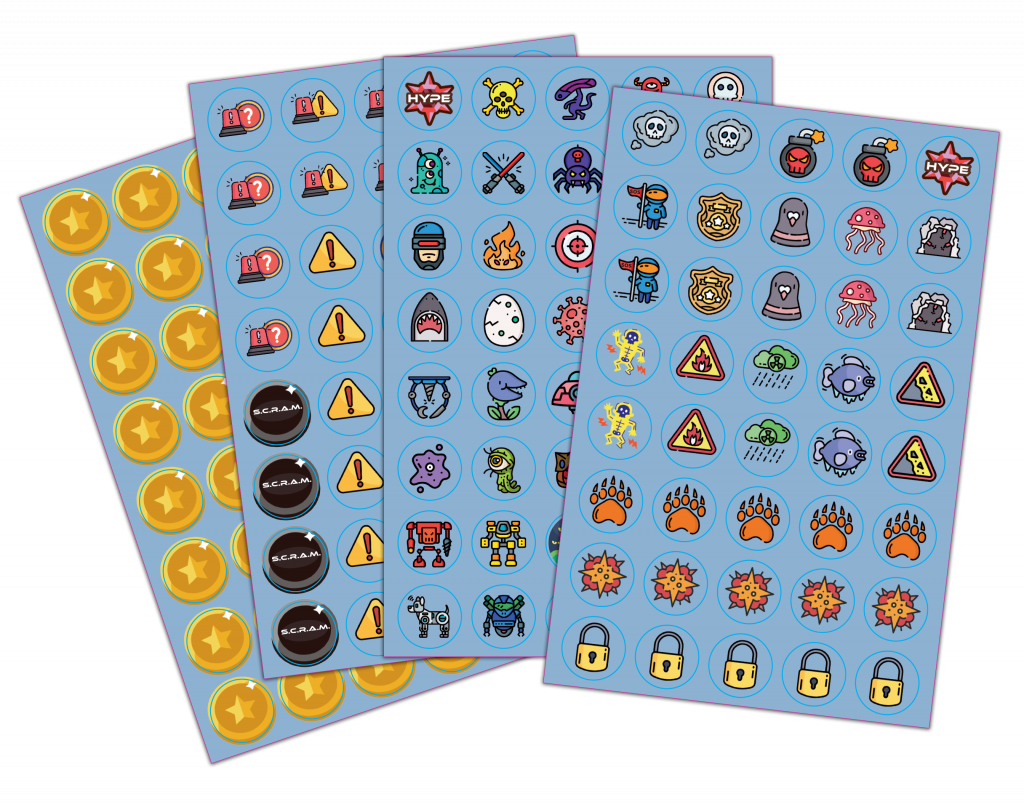
I made enough Space Cred tokens so that you can put one on every module of a starwreck with plenty left over.
When a character enters a module for the first time they add the token to their Space Cred stash. On the flip side of the Space Cred tokens are the encounter types. Either an Obstacle, Threat, Other, or a combination of those three. This way you don’t have to roll for the encounter type each time and you are guaranteed a good mix of encounters.
In addition to this, I included tokens that could represent a variety of ongoing effects, denizens, monsters, and statuses like locked doors, hull breaches, radiation, plasma fires, space police, and more. This way it is easier for all to remember what is happening in each module should players ever want to return.
As the wreck evolves, you can physically see it becoming a living ecosystem. Tokens move. Hazards spread. The map tells a story.
The Red Alert Tower
A key to making dungeon runners interesting are torches. They are your timers, your lifeline. You can’t stay in that dank dark hole full of terror and treasure forever because your torches will run out and then the unseen monsters will eat you. But the deeper you go the more cool stuff you might find… oh the conundrum.
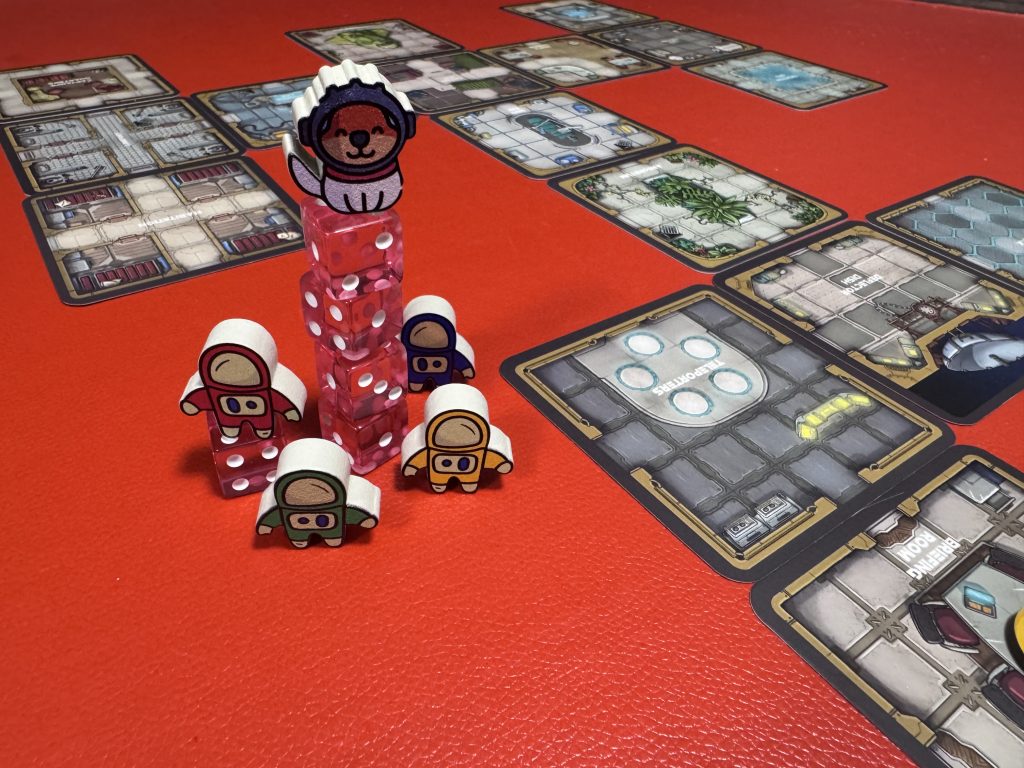
Enter the Red Alert Tower mechanic where every new room you enter you must add one d6 to the growing tower. The deeper you go, the taller it gets. And if it collapses? The Red Alert Catastrophe triggers.
The Red Alert Tower wonderfully simulates the rising risks of delving deeper into a dangerous environment. Sure you can always explore another room and earn more Space Cred, but you must risk triggering the absolute worst case scenario if it falls over.
As an added benefit to getting that stack as high as possible, the taller the stack is, the worse your rivals will do on their run. Risk isn’t just about survival, it’s about dominance on the leaderboard.
Because not everyone has a mountain of dice at home, the box set includes 20 square-edged hot pink d6s specifically for building the tower. It’s a mechanical centerpiece and a visual one.
The Push-Your-Luck Mechanic
Lately I’ve been loving push-your-luck mechanics in RPGs more and more. It adds so much excitement on the player’s side of things and makes things easier and more cinematic to narrate for the GM.
The core resolution is simple: You can keep rolling as long as each roll increases. A 6 is a total success. A 1 is the worst-case scenario. Everything in-between is shades of that.
The mechanic is easy to teach and it ends up telling a little story every turn. At first you try and very little happens, you keep pushing and start to see some progress, but then you push too far and everything backfires.
The key to making this work smoothly is clearly defining the worst case scenario danger you are avoiding before rolling.
That clarity makes every push meaningful. And the resulting rolls tell a story in miniature every single time.
The Other Goodies
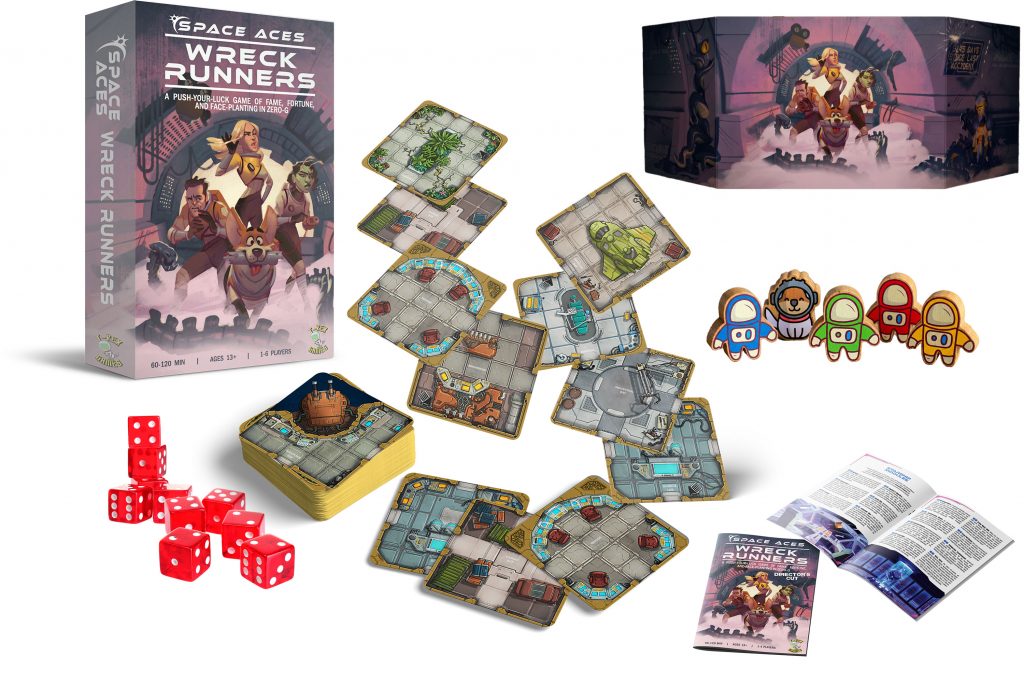
Wreck Runners is my first game where I included a GM Screen and I’m very unreasonably excited about it. Not only does it keep the basic important information front-and-center for a GM, it also has a cool “Space Junk” table for when players go poking around in various nooks and crannies and attempt to loot the room.
There’s also the Starwreck worksheet and map worksheet for the GM to fill out, as well a Hype-O-Meter to show the excitement level of the fans, and also character sheets for the players.
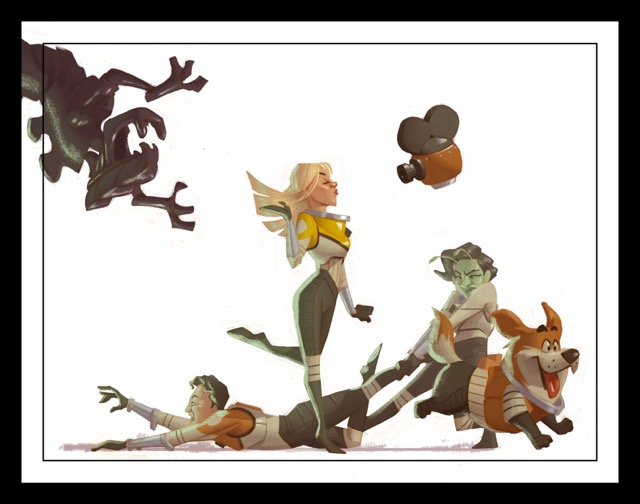
I’m adding five custom wooden meeples are included with the game wooden meepels. Yes, one is a space corgi. No, I will not mediate disputes over who gets to play the doggo.
Playing Wreck Runners Solo
Wreck Runners shines with a group, but it also works great solo.
It is a blast creating your own team of Runners, plunging them into the depths of a starwreck, rolling the random encounters yourself, and responding to them in character. Since everything beyond building the spaceship and deciding its 6 core threats is randomly generated with the Super Overloaded Encounter Dice, you genuinely don’t know what’s coming.
And it is up to you to decide just how far they press their luck to squeeze the most Space Cred out of each run.
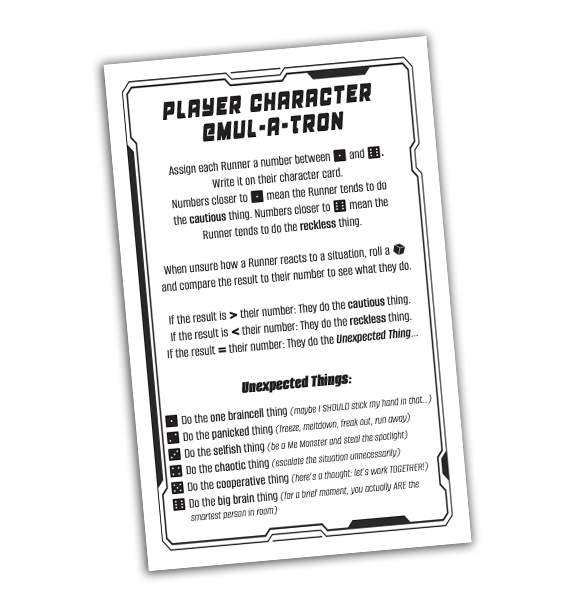
To support solo play, I am including the Player Character Emul-A-Tron tool as well. A dry erase card that helps determine how a runner reacts under pressure.
With a single roll, you can answer: “What would this chaos goblin actually do?” It lets you step back into more of a GM-observer role and watch the disaster unfold organically.
For a deeper dive into player character emulation tools, I highly recommend checking out Cezar Capacle’s Triple-O, which heavily inspired this inclusion.
The Inspirations
Wreck Runners didn’t appear in a vacuum. Even though space is a… yeah you get it. The game was inspired by quite a few different sources that you should definitely check out.
The biggest inspiration for Wreck Runners was the game Dead Belt by A Couple of Drakes. It is an outstanding game about generating random starships from a deck of cards and salvaging as much as you can before your oxygen runs out. The game is brutally hard, terribly tense, and wildly fun. I highly recommend it.
The core push your luck mechanic was inspired by a little game called Save by G0ri. I adored the concept, and am jealous of how much “game” is able to be communicated in what is essentially a business card sized product.
The dice stacking mechanic was inspired by the French game The Job by Andre Novoa which uses a growing tower of dice to represent the rising tension of a heist perfectly.
And I’d be remiss not to credit Slugblaster as THE major influence in tone and general vibes. I’ve called Wreck Runners “slugblasting in space” since you are essentially playing a bunch of skater punks grinding rails and tagging spaceships.
There are board game influences too like Battlestations: Second Edition and Galaxy Trucker, both of which celebrate modular construction and chaotic space problem-solving.
Does This Spark Joy?
I have had an absolute blast creating Wreck Runners.
Designing it gave me permission to zoom in on everything I love about fungeon games: the room-by-room tension, the weird discoveries, the emergent chaos. And it let me strip away the parts I don’t. What’s left is dungeon crawling with neon spray paint on the walls and a livestream chat screaming, “DO IT FOR THE CRED!”
From the beginning, I worked hard to make it easy to run and welcoming to play. I wanted something that could hit the table with minimal prep, clear rules, and components that spark ideas instead of slowing things down. And I wanted it to be genuinely family-friendly, something you could play with kids, teens, adults, and the permanently young-at-heart without having to sand off sharp tonal edges.
If it succeeds at anything, I hope it succeeds at sparking joy at your table.
Joy in building a ridiculous starwreck out of tiles.
Joy in stacking that Red Alert Tower one die too high.
Joy in pulling off a stunt that absolutely should not have worked.
Joy in watching your Runner get SCRAM’d out at the worst possible moment.
Joy in creating memories that will last a lifetime with friends & family.
This has been one of the most ambitious, mildly terrifying, and deeply satisfying creative risks I’ve taken so far.
Which feels… thematically appropriate.
Thanks for reading. Now go crack open a drifting wreck and see what’s inside. Adventure awaits.